
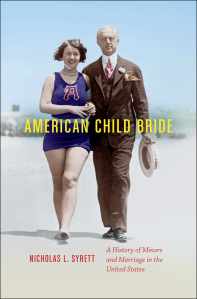
Friends, today I give you a guest post from Nicholas L. Syrett, my BFF and neighboring historian in Northern Colorado. His second book is out now–American Child Bride: A History of Minors and Marriage in the United States. (That’s the cover on the left, featuring a striking photo of “Peaches” and “Daddy,” a.k.a. Frances Heenan Browning and Edward West Browning. They were among the biggest tabloid sensations of the 1920s–she was 15, he 51. when they married in 1926.) Here below, Nick gives us some of the deep history behind anti-child marriage activism in the U.S., and concludes with some thoughts about a 70-year old presidential candidate this year who as he gets older, marries women who are younger and younger. What does age asymmetry in marriage say about gender roles in our era?
When most Americans hear the phrase “child marriage” they probably think about it happening elsewhere: India, Africa, the Middle East. The practice is indeed widespread in other parts of the world but thousands of legal minors marry in the United States every year as well. Every single state allows teenagers below the age of 18 to marry with some combination of parental or judicial consent. In some states the minimum marriageable age goes as low as 12.
All of this should concern us. But as I discovered in researching my new book, American Child Bride, these have been longstanding concerns of feminists in the United States.
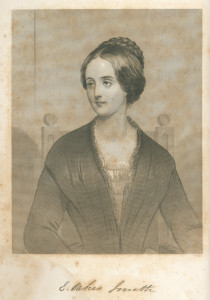
Among women’s rights advocates of the mid-nineteenth century Elizabeth Oakes Smith (1806 – 1893) was the foremost opponent of the marriage of legal minors. She is now largely forgotten by most scholars of American feminism, but she was quite influential in her day. She published widely, including poetry and fiction, spoke on the lyceum circuit, and authored a series of columns in the New York Tribune that she called “Woman and Her Needs.” They were collected and published in 1851 in a book of the same name. Smith had been married herself at age sixteen in her native Maine and as she explained in the unpublished autobiography she penned late in life, it was “the great life-long mistake.” But it was a mistake that she had been pressured to make by her parents and her fiancé, at a time when she believed she should not have been capable of consenting in the first place.
Feminists like Smith pointed to inconsistencies in the law of marriage—in almost all states, the age of consent to marriage was lower for girls than for boys beginning in the colonial era, and in almost all cases girls could marry before age 21, the age of majority for most of our history. This meant that all girls were capable of consenting to marriage before they had reached legal adulthood. And in some states in the middle of the nineteenth century (the first moment when reliable vital statistics are available), upwards of 40% of all female-bodied people who married did so as legal minors. Before these girls could enter into any commercial contract or make a will they were perfectly capable of entering into the one contract that, in almost all cases, lasted a lifetime. It was also a contract that, because of coverture, evacuated adulthood of almost any of its legal significance.
While it is clear that marriage was one of the only ways that a girl (or boy) could legally emancipate herself from her parents, which was useful if one lived in an abusive home, in the aggregate early marriage moved girls seamlessly from dependents in their fathers’ households to dependents in their husbands’. Marriage turned girls into “perpetual minors,” to use the phrase favored by many women’s rights activists at the time.
In one of her columns in the Tribune, Smith wrote:
Now, here is a contract. One party is mature in life—experienced not only in the world, but in the nature of his own soul, its needs, its capacities, infirmities, and powers. The other party is a child, an infant in law, whose pen to a commercial contract would be worthless … Yet this girl, this child, is party to a contract involving the well-being of her whole future life; a contract by which she is consigned to sickness, care, suffering, coercion, and her individuality completely suppressed.
Smith went on to indict any man (which would presumably have included her own husband) who would enter such a contract with a legal child, precisely because he was availing himself of her inexperience in gaining her assent to the marriage in the first place.
Elizabeth Oakes Smith was not alone. Activists like Lydia Pierson, Elizabeth Cady Stanton, and members of the influential Blackwell family also focused on the intersection of age and marriage in their crusade for women’s rights, and following the passage of the Nineteenth Amendment, members of the National Woman’s Party also worked at the state level to equalize minimum marriage ages state by state.
American Child Bride argues that age provides a crucial way to reexamine the history of marriage law in the United States, and indeed the history of legally gendered adulthood itself. And while the numbers of minor brides and grooms in the contemporary United States pales in comparison to their numbers even as recently as the 1950s, it remains the case that almost all American men continue to marry women who are younger than they.
Age asymmetry in marriage is by no means a thing of the past and in its more extreme form it remains a way for older, wealthier, and more experienced men to maintain dominance within their marriages. We need look no further than the current Republican nominee for president, who has successively married women who are three, eighteen, and twenty-four years his junior. While none of Trump’s wives has been a legal minor at the time of her marriage, Elizabeth Oakes Smith believed that age asymmetry in marriage made it difficult for men to recognize “the entire individuality of Woman, her claims as a creation distinct, and one; not as a half—a supremacy—an appendage—a mere luxury for the delectation of man.” Marrying women solely for their youthful beauty establishes a dangerous precedent for the functioning of a marriage, and a woman’s place within it.