
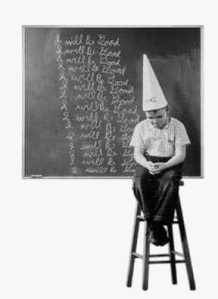
 Mark Bauerlein, a not-that-old fogy at an elite university, wrote something cranky about the practice of higher education in the New York Times last weekend. The column has been subjected to a ritual beating by many in the academic blogosphere. Yesterday, a call went out from David Perry (@Lollardfish on Twitter, and the blog How Did We Get Into This Mess) that he “would like to see R1 profs engage in a loud and public conv[ersation] ab[out] teaching and research.” Although I teach at an R1, it’s the Aggie school in my state and certainly not “elite.” I also don’t teach Ph,D. students, as my History department offers just a Master’s Degree.
This year, as regular readers know, I’ve been far away from the grind at Baa Ram U. and on sabbatical at the Huntington Library, a.k.a. “Scholars’ Disneyland.” I’ve been living much like a Renaissance scholar, dining at the table and enjoying the luxuries of my sponsoring Prince–that is to say, nothing like my real life, but you know what? The conversations I’ve been having here with the Distinguished Fellows–all of whom teach at elite universities and supervise Ph.D. students as well as undergraduates–frequently revolves around teaching, and yes, teaching undergraduates! How do we reach them? How do we get them to become and remain History majors? What subjects interest them most, and how can we use those interests to develop an aptitude for historical thinking?
We’re like young parents who want nothing more than a night away from the children, and then we end up talking about the children the whole time we’re out to dinner.
This is no different than the conversations that I have with my colleagues at Baa Ram U and my friends at other universities: we think and talk about our students all the time, and although sometimes we may complain and kvetch about a problem student here or there, for the most part the conversation is focused on how we can grab and hold their attention, and how we can ignite spark of intellectual engagement. So I don’t know who Bauerlein is working with at Emory that he sees such a monumental level of faculty carelessness about their students and their teaching responsibilities. (I’d love to see a candid review by some of his colleagues about this claim!)
At Baa Ram U., teaching matters. Teaching is 50% of my job description, while research counts for 35% and service the final 15%. Although that 35% seems to count for a great deal more at tenure and promotion time, I would say that in my department, it’s a necessary but insufficient component of our portfolios. We must demonstrate teaching effectiveness as well.
 Now let me return to Bauerlein’s lament. As LD Burnett has explained in greater detail that I can, one of the big problems with his analysis is false nostalgia for the campus of the 1960s. But anyone with a passing familiarity of the history of higher education knows that students have been at odds with the faculty for at least two hundred years, seeing them then, as now, as joyless buzzkills who mistakenly think that college is about scholarship rather than fun and fellowship with one’s peers. (At least, that’s a big lesson I took away from Nicholas L. Syrett’s The Company He Keeps: A History of White College Fraternities, and some of my other reading on the topic.) So to claim that in the 1960s, or the 1920s, or the 1890s, or the 1860s, or the 1830s that “naturally, students looked to professors for moral and worldly understanding” is a pretty laughable claim based on the evidence left us by generations of college students, faculty, and administrators.
Some students surely did look to the faculty for wisdom and guidance, as they do nowadays, but let’s be honest: in our bumptious democracy, college faculty have always been viewed with suspicion and disdain as oddballs, eggheads, or even decadent leftist fifth-columnists! (We should be grateful for these moments of relative equipoise in national affairs when our intellectual interests render us merely irrelevant rather than treasonous!)
As I re-read Bauerlein’s column this morning, I was struck not by how much we disagreed, but by how much we agree: we need to reach our students better! We need to make the case for our own relevance in their lives, as they’re not going to come to that conclusion on their own. (I teach a number of first-generation college students, who aren’t as well prepared to navigate the challenges of college or to take advantage of the resources available at a university.) He’s right that forcing students into our offices and into face-to-face contact is a powerful way to help our students get the most from their time with us.
I wish he had talked to those of us who teach at non-elite universities or community colleges, however, before claiming in his introductory paragraphs that today’s professors hand out 4.0s like paper towels and never make demands on their students. I just ran the numbers: in my upper-division lecture course in colonial North America last spring which drew 35 students, I gave out 8 As or A-minuses (23%), 13 B-range grades (37%), 4 Cs, 3 Ds, and 4 Fs. (Three students withdrew from the class without taking a grade or credit.)
In my lower-division survey course, the failure rate is even more shocking. I delivered Ds and Fs to fully one-third of my students! And yet, as Bauerlein reports, my office hours are usually empty of students, although at the beginning of the semester I offered them ten free points for just dropping in to my office to have a conversation with me about anything at all! (To be sure, this is one of the reasons I’ve been interested in conversations about teaching this year. I don’t like failing students, and believe that it’s incumbent on me to find ways to convince students to do the required work and devise the means to help them.) At the same time, I don’t believe in lowering my standards either–a college degree from Baa Ram U. must mean something, or it means nothing. Maybe Bauerlein’s peers at elite schools need to start kicking asses and taking names, but we who teach at non-elite institutions see grade-inflation as a myth at our schools.
I think what bothered many of us who teach at non-elite universities was the implication that faculty and faculty alone are responsible for alienating our students, when student disengagement is a phenomenon driven by decisions far above our pay grade. Back in Bauerlein’s halcyon days of the 1960s, the University of California charged zero tuition! (We can be legitimately nostalgic about that.) Now, many of our students are busy working nearly full-time jobs to help the pay for college, and the majority of their professors are unable to find tenure-track employment to help them pay back their student loans and make a middle-class living! The decision to shift the costs of their educations to the young were made by politicians and university administrators, not mere faculty.
Another factor driving the notion that attending classes and talking with professors is an optional (rather than optimal) feature of college today is the move towards online education. When my university runs commercials on local television and advertises in print and on billboards that it can offer you a college education “in your spare time” and “conveniently” online, are we surprised that students see us as interchangeable evaluative widgets?
 In the end, though, I’m a little confused about Bauerlein’s apparent dismay about his students’ lack of interest in engaging with him in particular, rather than professors in general. I’ve been warning people for years not to complain about your students on Facebook or write uncharitable blog posts about them! Even if you’re absolutely in the right, it’s an abuse of your authority as a faculty member. Even if you’re writing anonymously or pseudonymously, most of our students are foolish and young and maybe a little callous, not guileful schemers.
But if you write and publish a book called The Dumbest Generation. . . or, don’t trust anyone under 30 and happily make a name for yourself punching down, no wonder that students don’t see you as an honest broker for (in the words of his NYT column) “moral and worldly understanding,” let alone a subject for “emulation.” Or, in the words of Erik Loomis, “What an Asshole.”