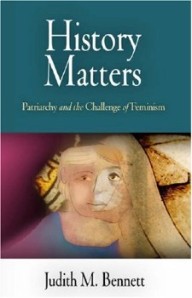
 Part II of Judith Bennett’s “History Matters” Women’s History Month book club. If you haven’t seen it already, go read Part I here.
When my copy of Judith Bennett’s History Matters: Patriarchy and the Challenge of Feminism (2006) arrived on the doorstep earlier this winter, I sat down and devoured it. Yes, it was my constant companion, and even bedtime reading. At times in the initial chapters, it read like a feminist version of Peter Novick’s That Noble Dream,with bits of gossip dropped here and there (although, frustratingly, I wished that Bennett had dished more than she does–she doesn’t always provide citations when she suggests that people wrote or did something she disapproves of. However, if you’d like to know what a complete tool Lawrence Stone was, I can direct your attention to p. 14, footnote 36. The cited condescending book review is available by subscription only on-line, but you can get some of the flava by reading Joan Scott’s angry response here.) I love Bennett’s passionate, informed conviction that as women’s history has become more institutionalized and thus more distant from the women’s movement, it has lost something vital.
Last week over at Notorious Ph.D., Girl Scholar, several of us got into a discussion about the generational angle of Bennett’s book. In History Matters, Bennett writes about the excitement of being a graduate student in Toronto in the 1970s at the height of the modern women’s movement, coming out as a lesbian, and helping to invent women’s history all at the same time. She also writes about her keen disappointment that succeeding generations of women’s historians have lost the founders’ zeal–and although she doesn’t say specifically, my guess is that Generation X women like me are a big part of her disappointment. We went to college in the 1980s and grad school in the 1980s and 1990s as beneficiaries of the feminist movement who didn’t necessarily think we needed to call ourselves feminists. We were convinced that all of the major battles were won, and that we could therefore study whatever we wanted, and have careers and wonderful lives as the first post-feminist generation free of the oppressive legal and economic structures and cultural and religious beliefs that ensnared women for centuries–until now! Weren’t we lucky? (For the record: I was generationally unfashionable in that I always considered myself a feminist and embraced the label, but I was tragically naive until my late 20s about my generation’s ability to escape the bonds that have governed women’s lives for millennia. In the previous discussion, Belle pointed out that dividing up historians into generations isn’t so neat and clean–for the record, “my generation” means mostly my grad school generation, in that I think it’s when people trained that’s most relevant here.) Perhaps my thoughts here are too much informed by my generational identity, but I think that a greater appreciation for what Bennett calls “the distant past” in chapter 3, and therefore a better sense of what she calls “patriarchal equilibrium” in chapter 4, would have tempered my youthful arrogance that the rules for women and men had changed completely and that I could just enjoy the benefits without having to continue the fight.
Bennett’s insists that the ancient and medieval past is still relevant to history and to feminism, and she is concerned that women’s history has become almost by definition a modern history field. Bennett’s research in chapter 3 demonstrating the mad rush to modern history in the historical profession in general, as well as in women’s history conferences and journals in particular, provides conclusive proof of the abandonment of pre-modern and even early modern history (at least by comparison to their presence in the infancy of women’s history in the 1970s). As someone whose publications are in seventeenth- and eighteenth-century history, I’m poised in-between medievalists like Bennett and the majority of women’s historians, whose work is in twentieth century history, but I’m more sympathetic to the view that the so-called “distant past” is valuable (perhaps, admittedly, out of self-interest.)
One major reason women’s historians have gravitated to modern history I think is that most of us want to write books with happy endings. As feminist readers and writers, students and professors, we want to think that the women’s movements of the past 230 years have borne some fruit. This yearning for happy endings is something I see all of the time in the classroom. Anyone who has taught women’s history across four centuries (as I have in the past) knows that students are demonstrably giddy once we get to around 1800, and can finally talk about feminism through the writings of Olympe de Gouges, Judith Sargent Murray, and Mary Wollstonecraft. The students who enroll in women’s history courses are largely sympathetic to feminist values, and once we get to modern history’s rapid pace of apparent change, and events (in American history) like the abolition of couverture and slavery, women’s suffrage, the Civil Rights Act of 1964, and Sandra Day O’Connor, they’re looking forward to a happy ending that conforms with the Whig takeaway message of their U.S. history survey classes: American history is all about the spread of liberty, and everyone is getting freer and freer all of the time.
I now teach American women’s history up to 1800 only, and I can tell that my students think the course is a major bummer. From the start, it’s a horror show of starvation, disease, exploitation, enslavement, and rape, and then we conclude with the consensus view among early American historians that the Age of Revolutions not only does nothing for women as women, but that there is conclusive evidence that the eighteenth century is dramatically regressive for Native American, African American, and Euro-American women. (I had a complaint on my course evaluations last term that “we learned a lot about oppressed women, but not much about the majority of women.” Oh, how I wish I could teach that course, where the “majority” of women in the Americas from 1492 to 1800 weren’t “oppressed!” The problem is that it would have to be taught as science fiction, not as a history course!)
Bennett notes that while women’s history has become shallower in its focus on modern history, it has become broader with the inclusion of more women’s history outside of the U.S., Canada, and Europe. She (rightly) suggests that “[t]his is not an either/or situation; we need both more non-Western history and more early history (and sometimes, of course, we get both at once.) If the former has expanded at the expense of the latter, neither is to blame; instead, the elephant in the room looks to be the history of the modern West whose dominance over both seems to have yielded little ground, if any,” 41. Bennett’s demand here for more attention to pre-modern history is nothing short of a call for us to return to the longue durée of the Annales school, and is intimately connected to her demand that women’s historians embrace the fact that women’s history is more about continuity than change. This is a radically counter-cultural idea in the historical profession, which is all about the study of change over time. But, as Bennett points out, looking for change over time makes sense in some sub-fields, but perhaps not in others, and anyone working in women’s and gender history and the history of sexuality knows in hir bones that our fields are marked much more by depressing, confounding continuity rather than change. I can’t help but think there’s a generational angle to this, too–with a suggestion that social history (rather than cultural history, which is what all of the kids are into these days) is more useful for developing comparative studies of women across the centuries. (Bennett offers just such a case study with crunchy, raw social historical data in chapter 5, which examines the durabilty of the wage gap over the past 600+ years.)
Bennett reminds us that women’s history was radically counter-cultural–the mere suggestion that women’s lives were appropriate subjects of historical inquiry was a radical feminist idea back in the day!–and if we lose that urgency that we need to change history, then what’s the point of doing women’s history? We shouldn’t back away, or deny that we’re involved in a political project–history is always political, so why should we be more defensive (or worse, apologetic) about our work than any other historians? The whig narrative–and my students’ insistence that American history courses should always have happy endings–is extremely political, and much less grounded in evidence and reason than any women’ s history I’ve ever read. Don’t we take it for granted that the political position of Ethnic Studies departments is anti-racism (hardly a controversial position, by the way)? Don’t we simply assume that most environmental historians probably have a dog in the fights about environmental policy today? The comments to many of my posts on this blog attest to Generation X’s and now Generation Y’s discovery that the academy and its values have changed very little even after 40 years of feminist scholarship and activism inside and outside the sacred groves of academe–maybe we need to go a few decades or centuries back before 1964 to figure it all out. The fight continues–we didn’t pick it, but it’s our responsibility now. To the barricades, mes amies! Aux armes, citoyennes–la jour de gloire n’est pas arrivée.
P.S.: Don’t miss next week’s installment over at Tenured Radical, and the March 23 edition by Another Damned Medievalist at Blogenspiel! And stay tuned for announcements for our last installment, still in the works.
And now, over to you, my esteemed colleagues of the commentariat. . .